To A Portrait
Details TK
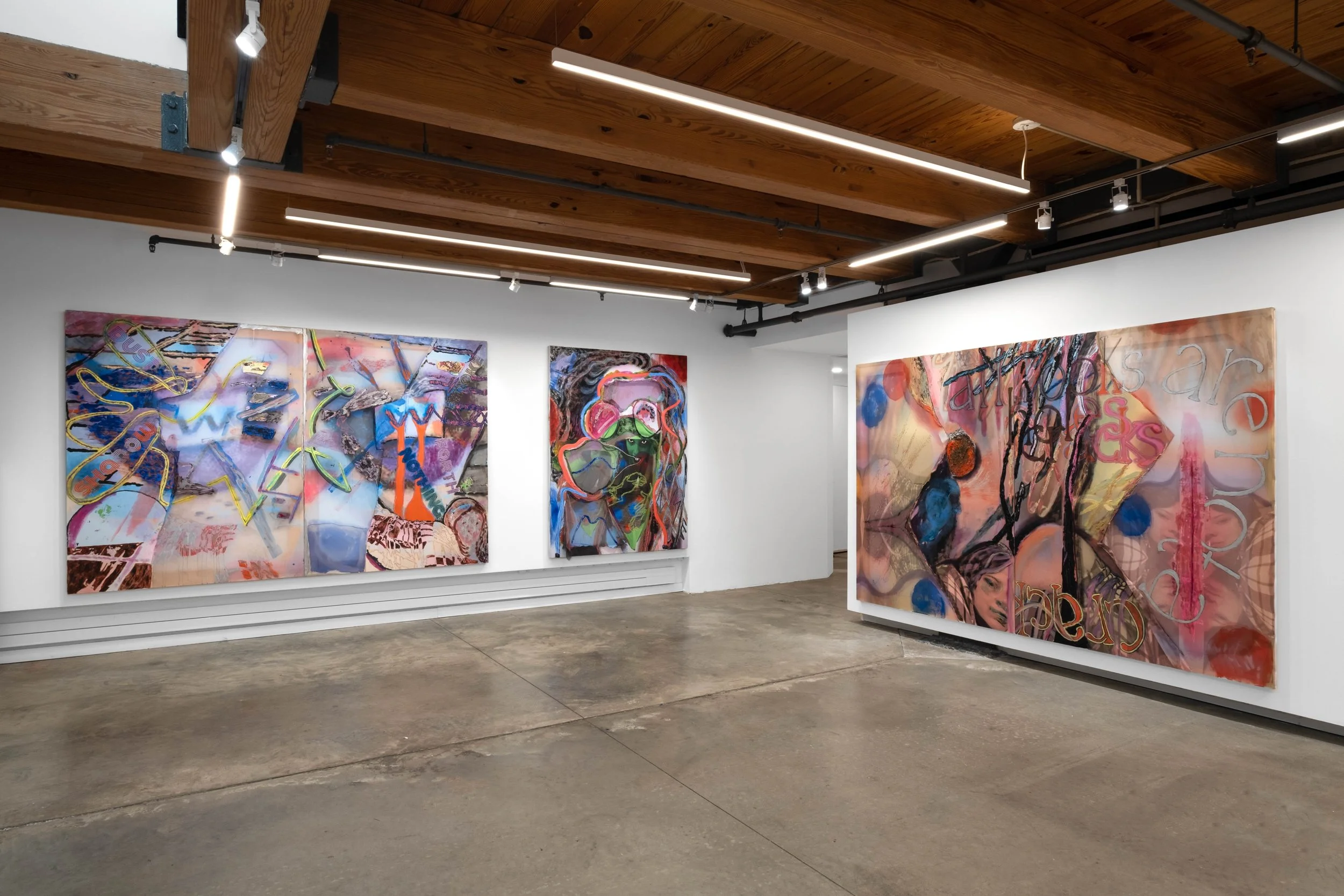
To A Portrait
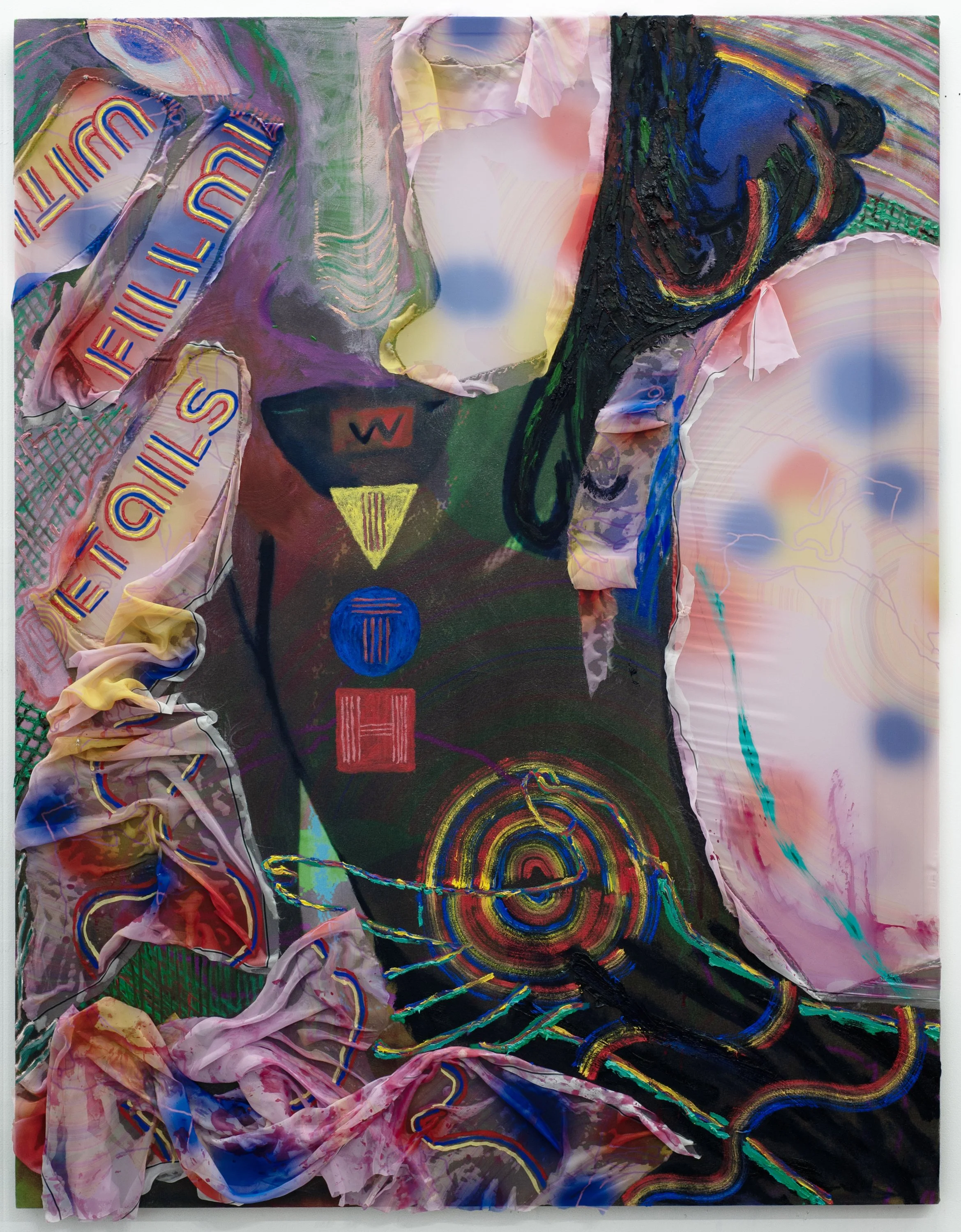
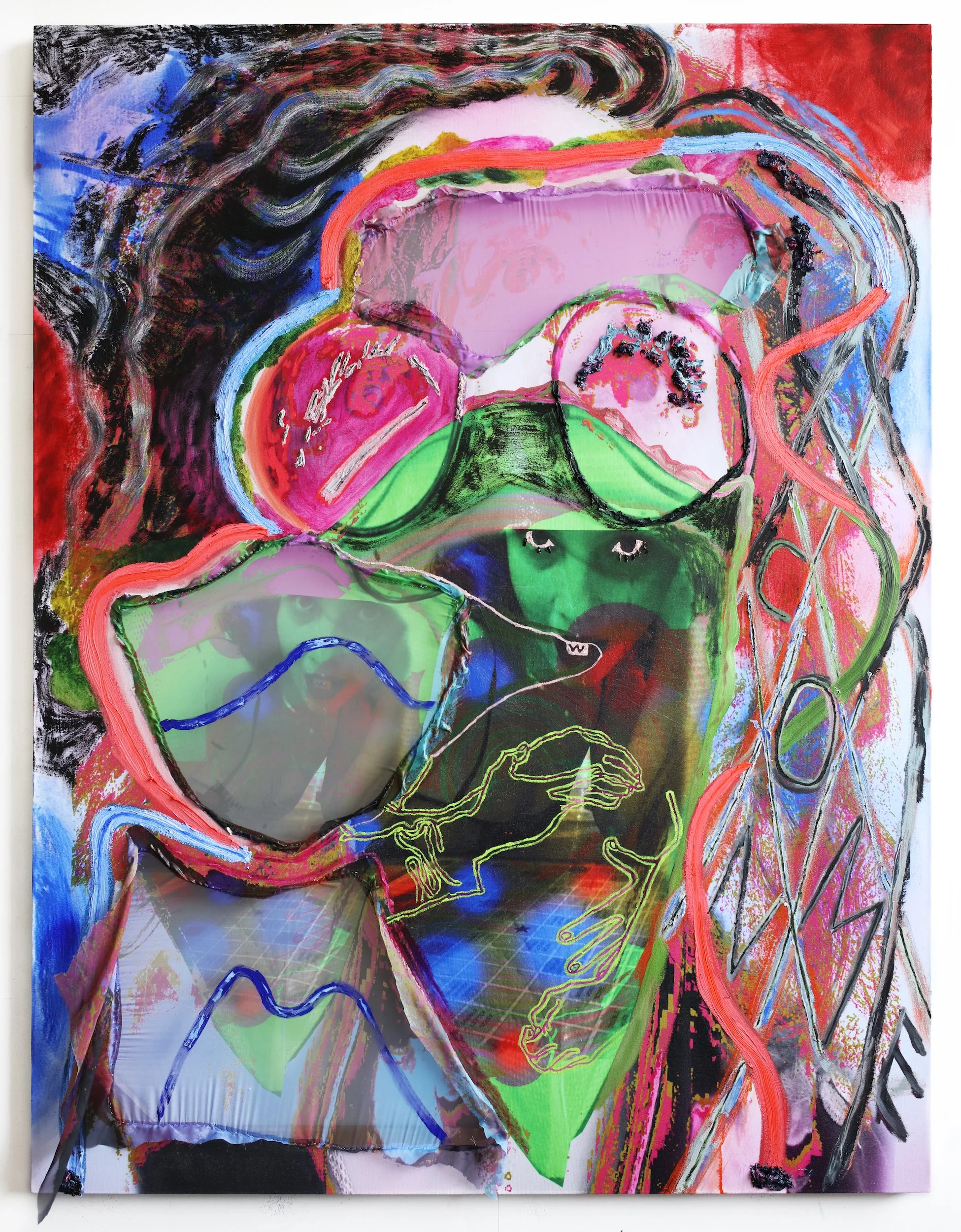
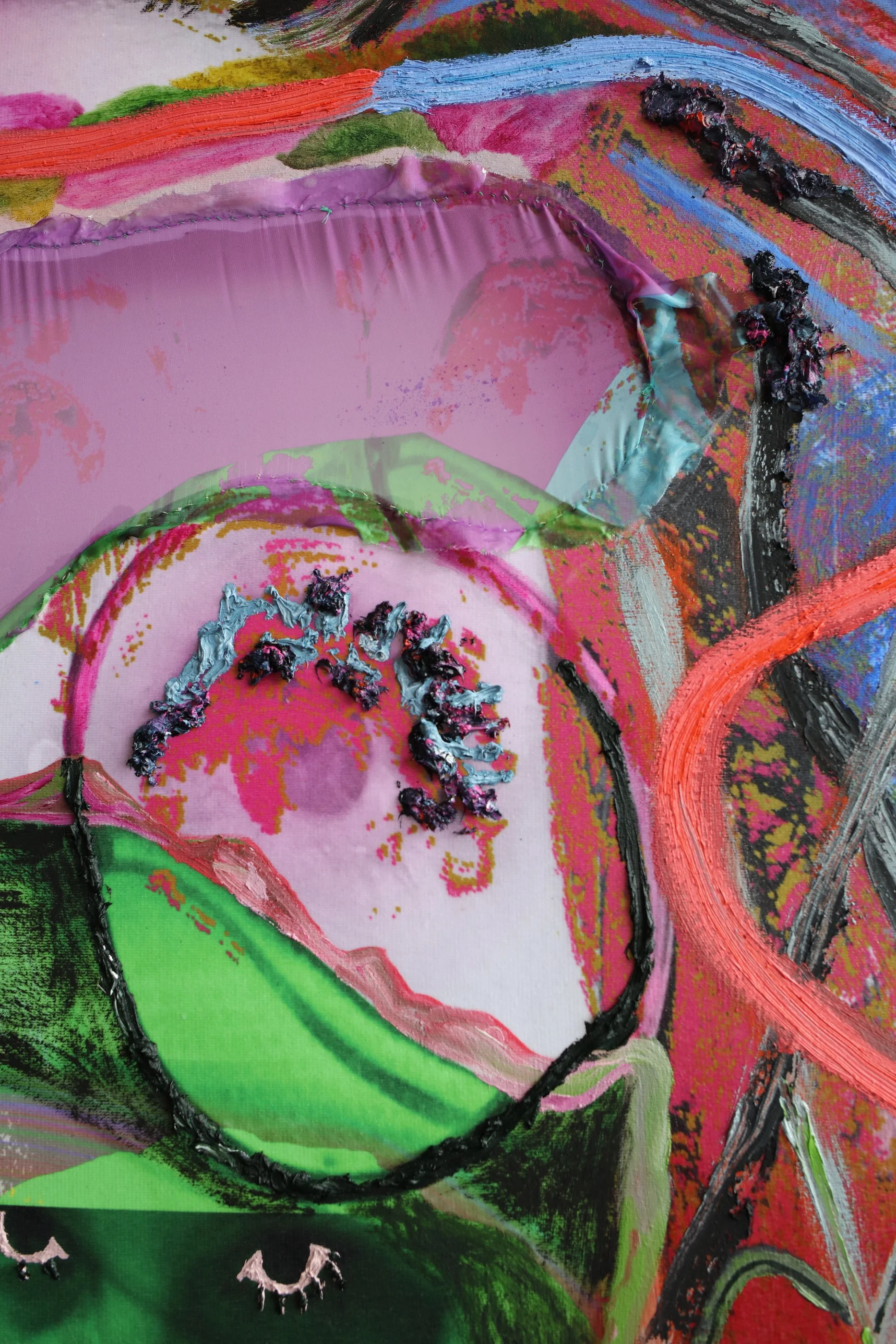
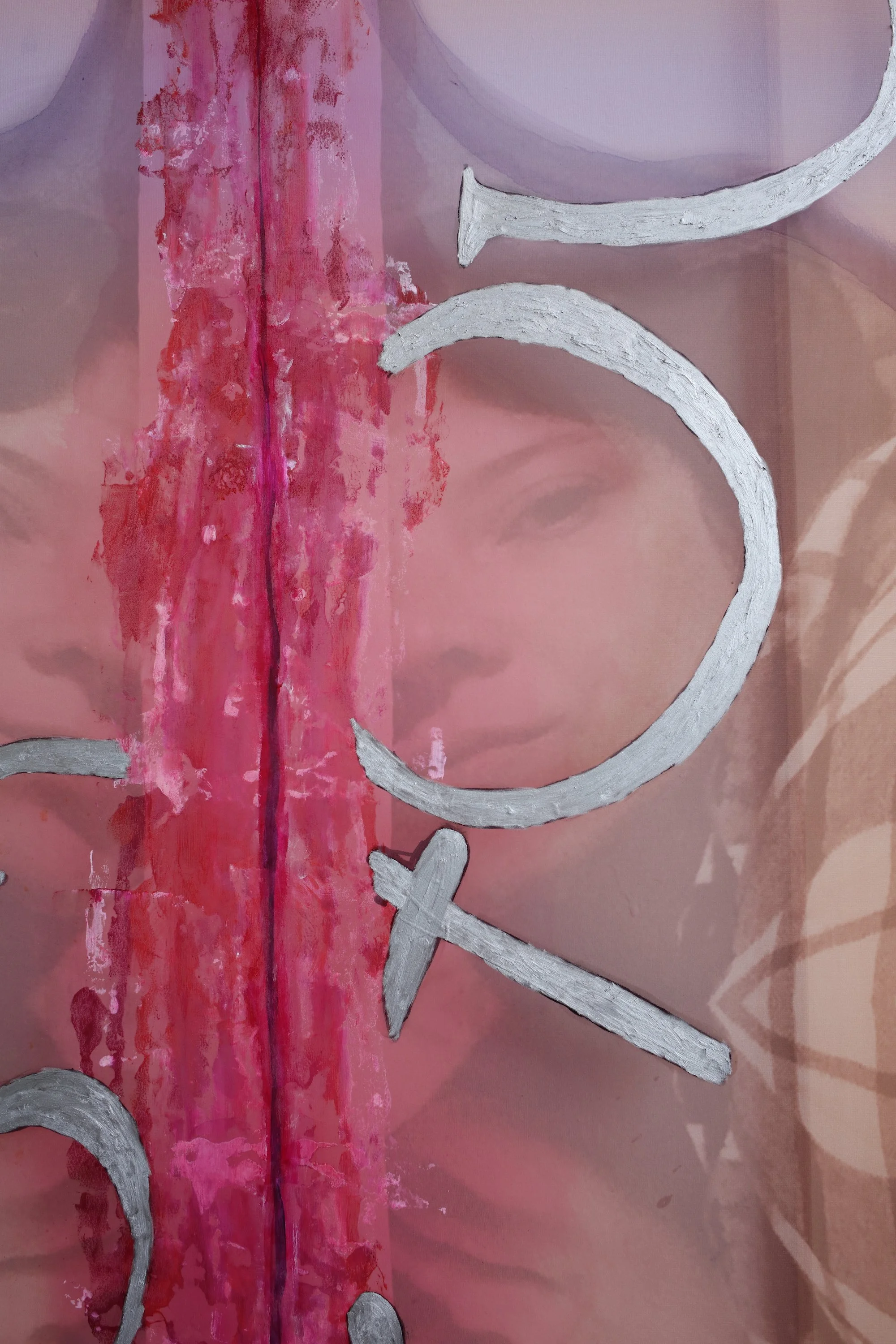
Who’s Afraid of Red, Yellow and Blue, 2022
oil and acrylic paint, digital photocollage print on beach towel and chiffon, 68 x 52 in (172.2 x 132.2 cm)
The title, who's afraid of red yellow and blue, is an immediate reference to the Barnett Newman paintings series—which I included both because I think of myself as a painter working within the logic of abstraction, and also because the main figure of this painting *is* a little scary. The figure, from a selfie posed with Scrabble tiles, is one that's green, sort of snakey, and lives inside of the green-screen mask also found in other paintings in the show. In this show, she represents a kind of libidinous image, a projection, and in this painting, she is given the full space of the canvas. What started out as a funny idea for a sexy selfie, with letters emerging from the mouth, became a way of trying to think through the enunciation of desire—the W between the lips both language and teeth. In this image the figure is also constituted by the chiffon fabric which forms her right eye, shoulder, and which is plastered along the left side of the canvas like a wet tshirt or bubbled skin. From her left eye, and out of her mouth, emerge the words: Fill Me With Details, an interpolated translation from the song Y Hubo Alguien by Marc Anthony , where Marc refers to a new lover as someone who wanted to fill him with details. The idea of filling with details is just what we do as painters, as well.
The painting is covered with red yellow and blue squiggles, a way of trying to get back to basics, and a small joke about the building blocks of color. The figure holds a circle made of these colors that hovers over her chest, like a broken heart, an urgent message, something held close to the chest.
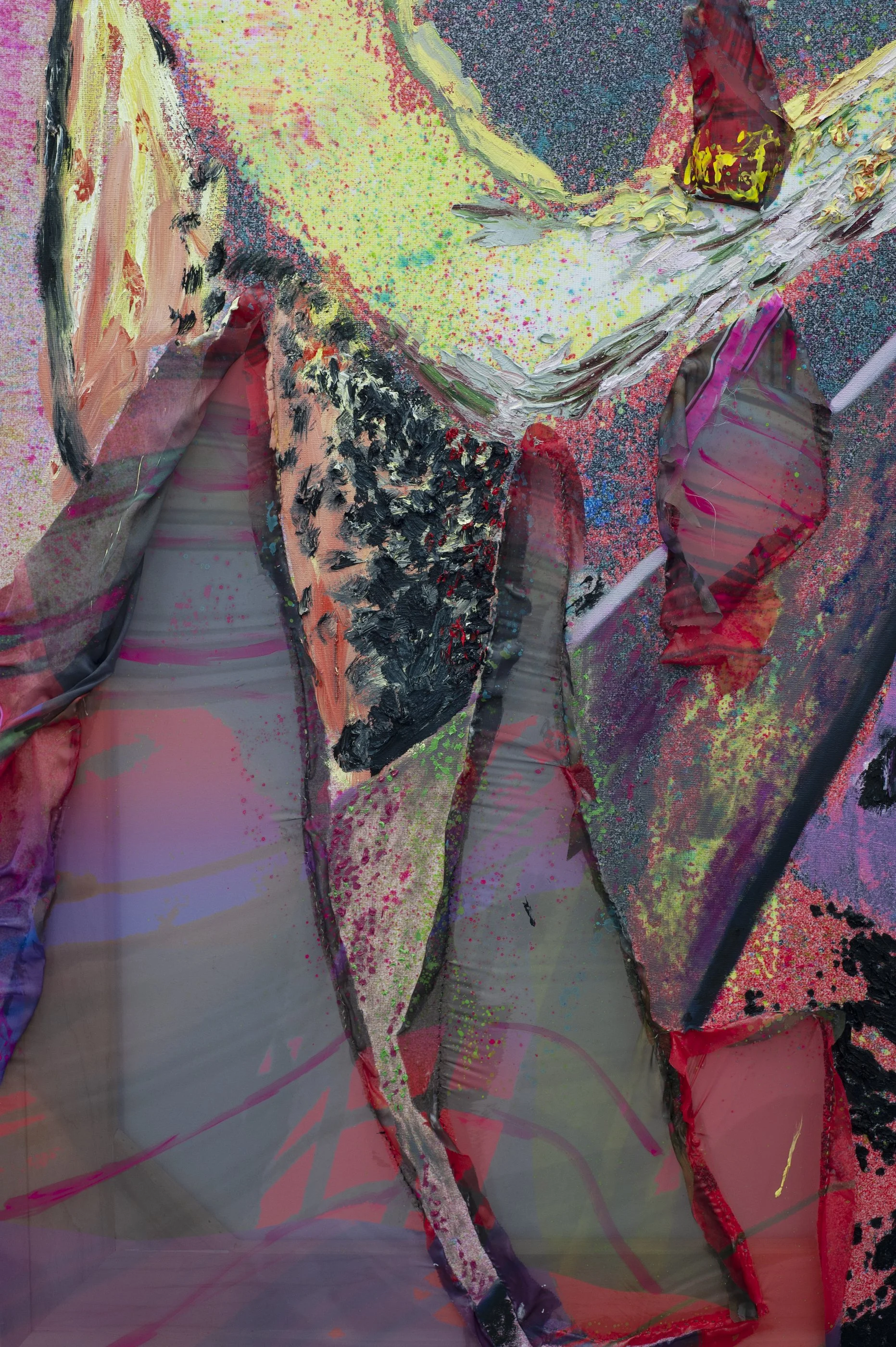
Shadow, 2022
Oil and acrylic paint, digital photocollage print on beach towel and chiffon, 68 x 52 in172.2 x 132.2 cm
The main imagery in Shadow comes from the painting The Flaying of Marsyas by Titian (for fun, I’m including an essay I wrote about the painting in 2016, because it is another long-term obsession). It’s a painting where Titian uses the myth of Marsyas, who challenged Apollo to a musical duel only to lose and be flayed alive as his punishment. The inverted figure in my painting is Marsyas, and the figure holding the knife is Apollo, although both are abstracted. Within the silk chiffon cutouts is the self portrait in plaid, looking out from the image with a sidelong glance. It’s an echo of the figure of Midas in Titian’s painting, said to be a self portrait of the artist, beholding the scene in order to evaluate its justice. I think of my own portrait in this as a way of putting myself in comparison to art history, but also winking outside of it.
One of the best things for me about Titian’s painting is that the theme of the myth is the flay, and the way he paints it literalizes the idea of paint as skin, with these broad brush marks, barely held together at the surface. I take this idea further by turning the image into something flayed, and also the knife as a tool of clarity, and even catharsis. My version of the image is run through photoshop enough times that I can also focus on this sense of imagined light, and the simultaneity of pain and pleasure, wrong and right, and getting exactly to the point.
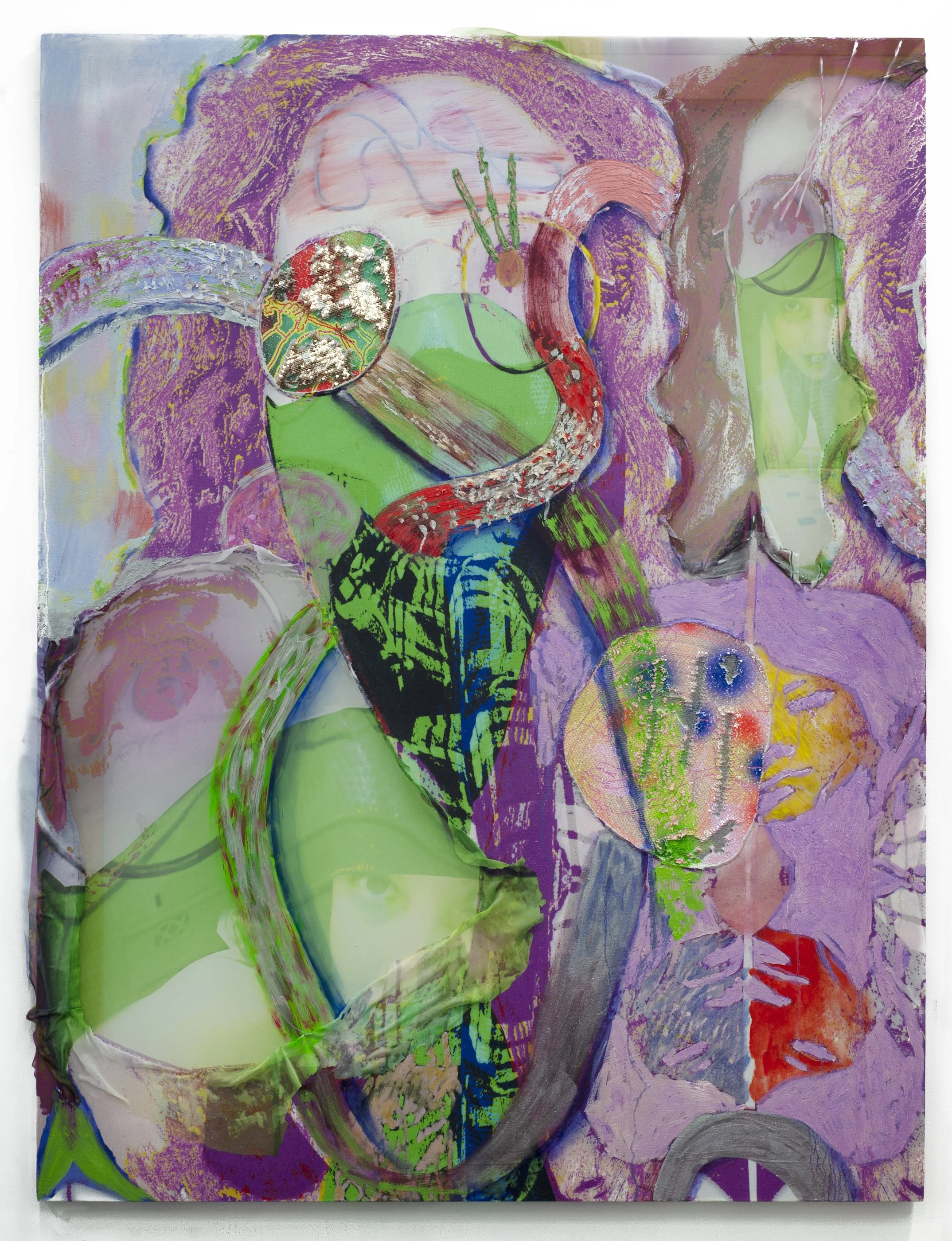
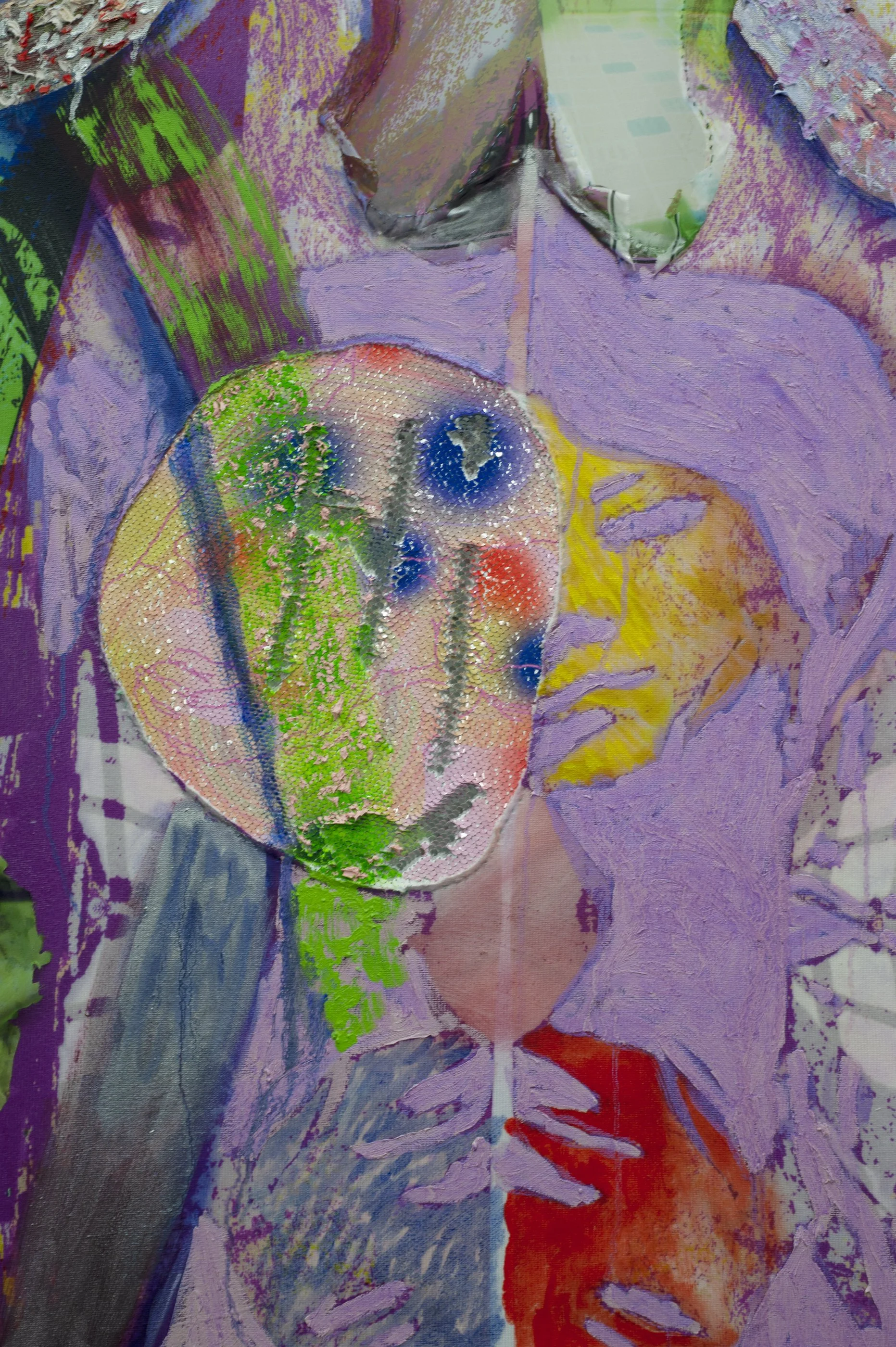
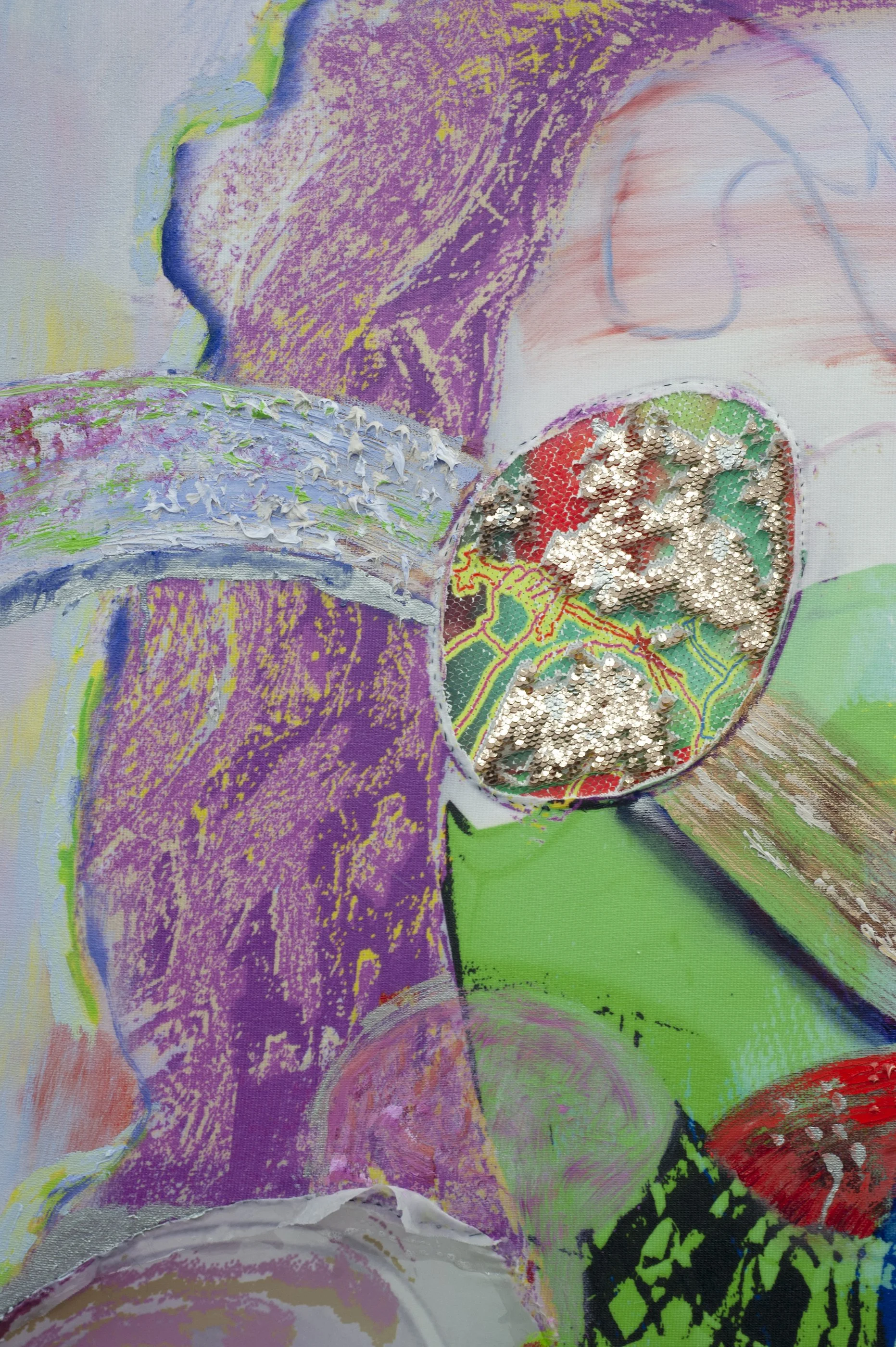
Navel Gazey, 2022
Oil and acrylic paint, digital photocollage print on beach towel and chiffon,, 68×52 in (172.2 x 132.2 cm)
Reflections are always multiple, partial, recurring. What version of the self exists in the mind, in our memories, in the various shiny surfaces and screens that we see and post our visage? This painting includes two areas of double-sided sequins which are printed on one side, and metallic on the other. One area covers an area corresponding to one frame of eyeglasses; the other covers one in a set of four reflected faces. In the glasses, the print, of a knife, is from the battle scene of Piero della Francesca’s mural the Legend of the True Cross in Arezzo. In the other segment is written the word “Hi.”
The painting is mostly green, unreal, imaginative, tied together with a loop like a bow or a roller coaster. There are a lot of gazes in this painting, a lot of reflected images. All the versions of self portraits that I use in the show are present in this painting, which incidentally, is not being shown in NY but rather in Miami: butt girl’s plaid flannel anchors the painting in the center; the face wearing the mask gazes up and outward as if for help or in a daydream, scrabble girl holds us in place. The color is bright and artificial, like a projection. I think of this painting as a good ambassador for this body of work: she carries reflections, excitement, doubt, shininess, memories, pain, longing, abstraction, and a whole lot of looks. The title is a joke about painting and self portraiture, the questions about looking inward as we look outward. In a way, this painting is the most interested in the interiority of the idea of the self, and the kinds of space that is made by this self-reflection.
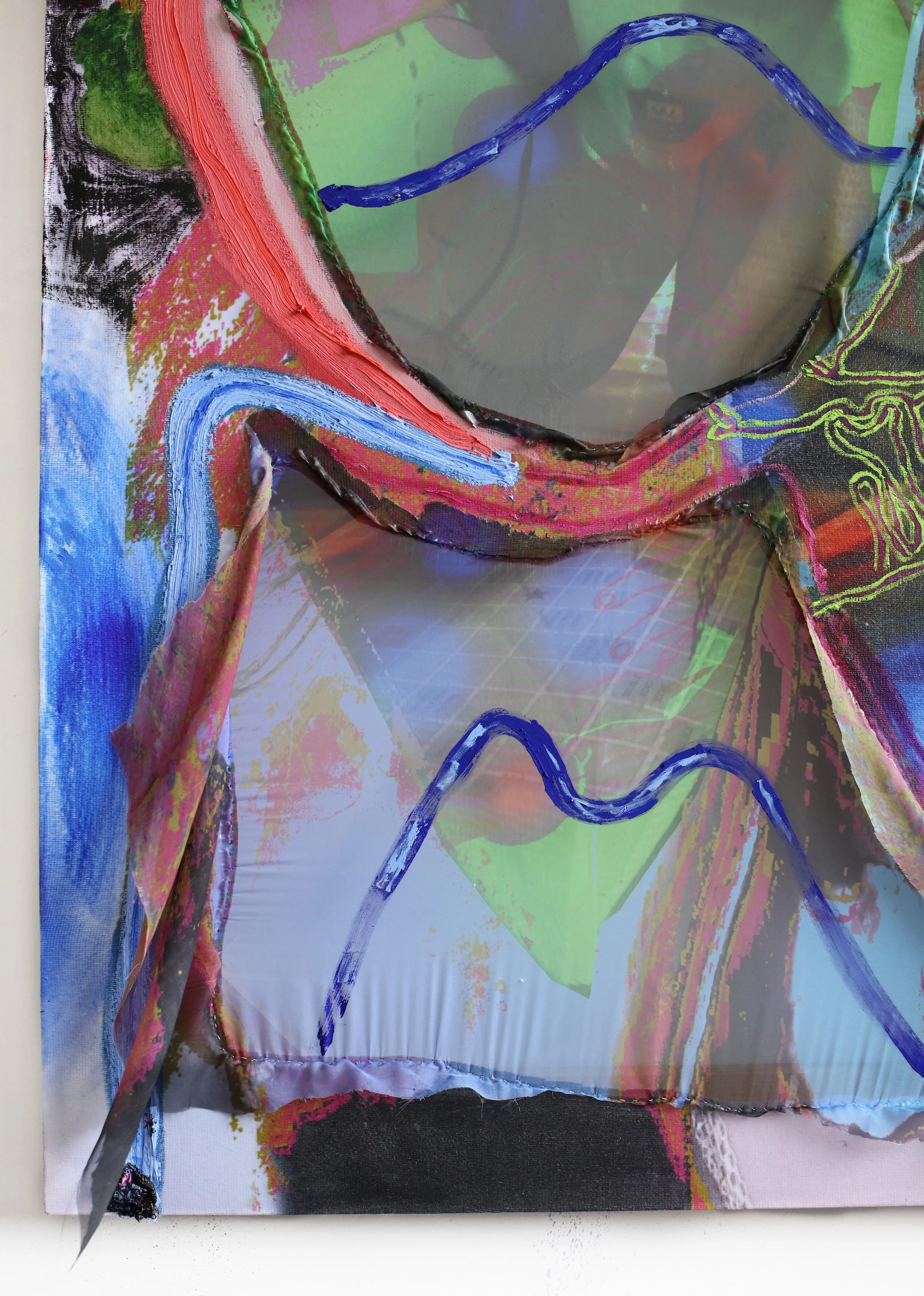
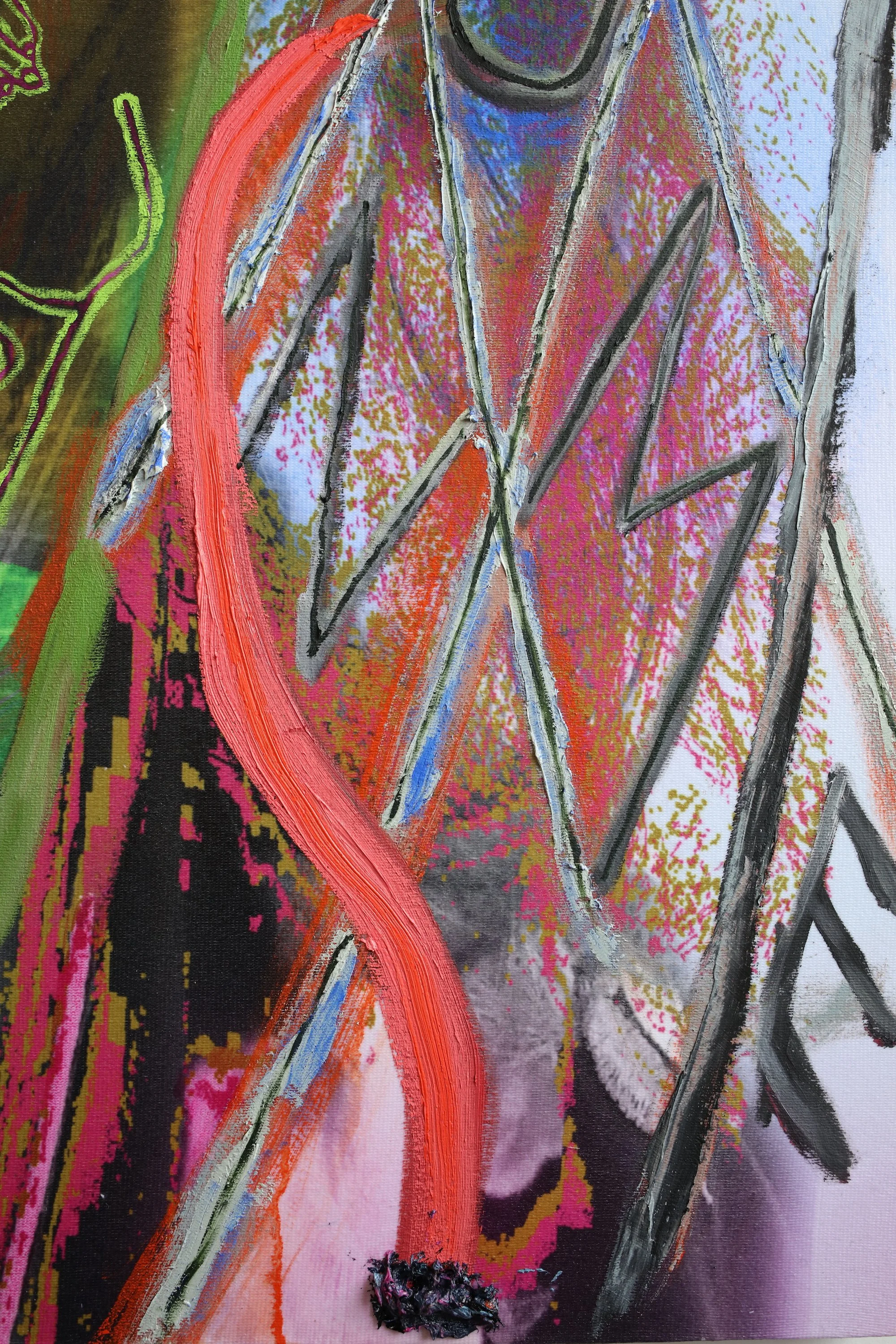
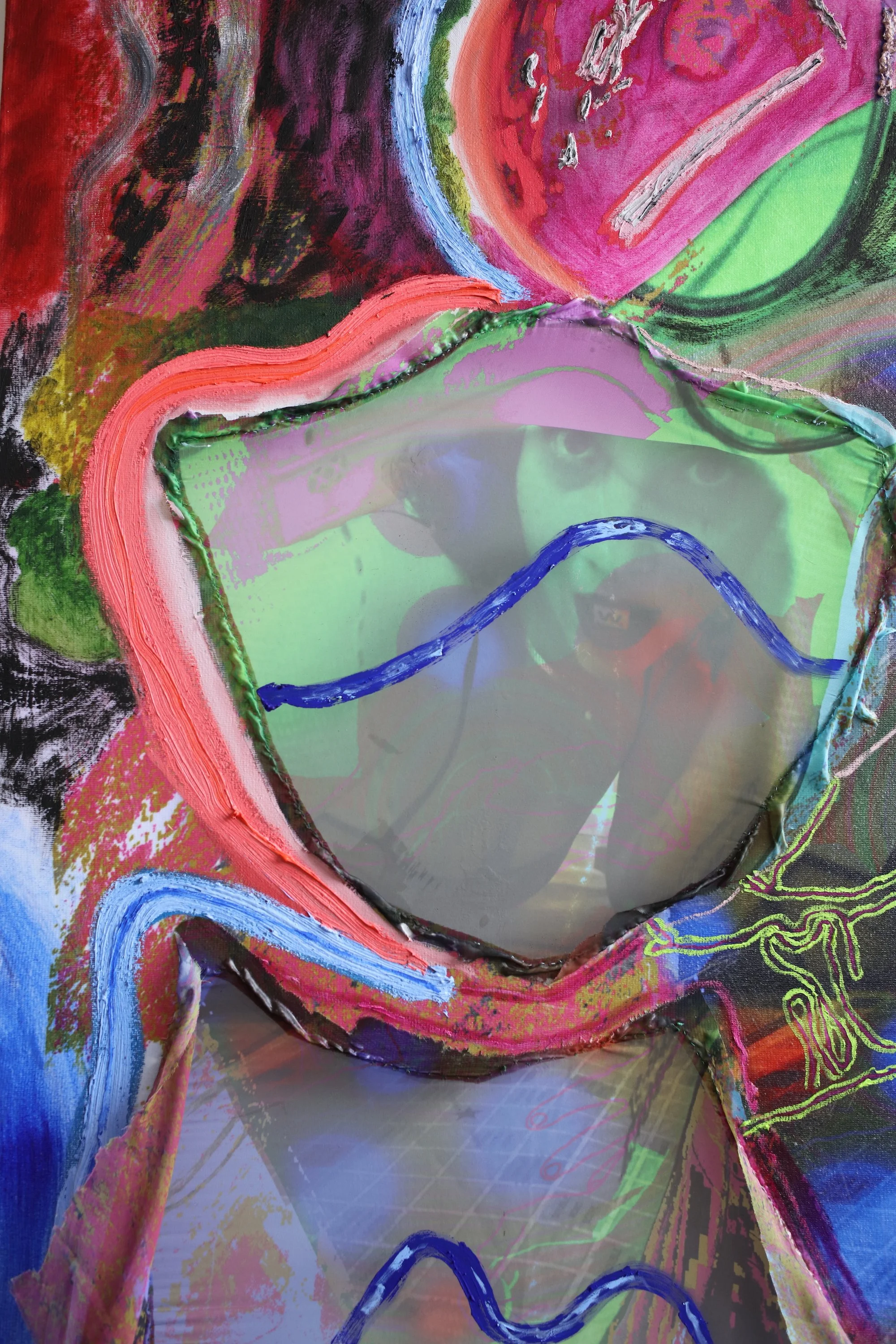
Mask Rapture, 2022
oil and acrylic paint, digital photocollage print on beach towel and chiffon, 68 x 52 in (172.2 x 132 cm)
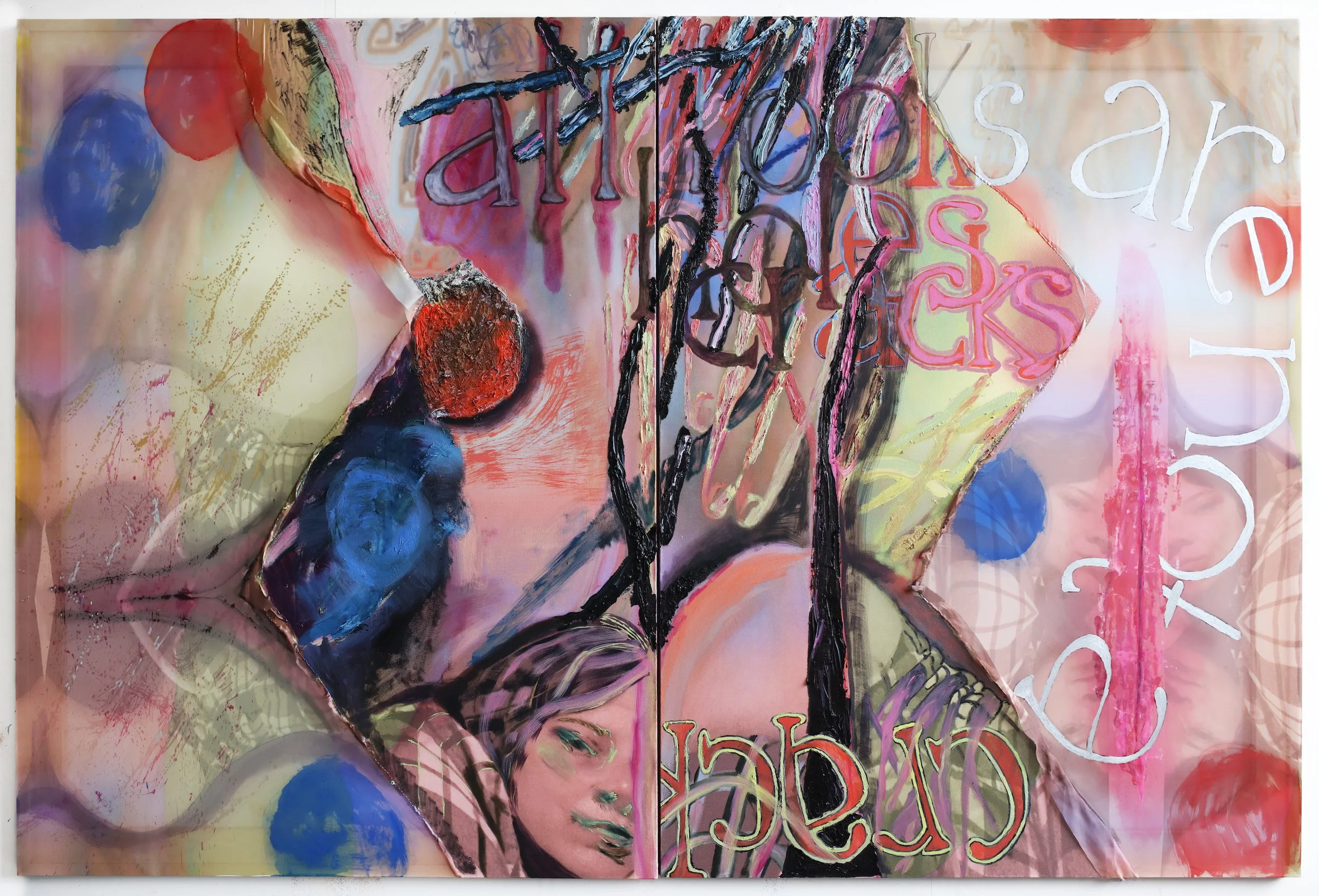
Fracture Mechanics, 2022,
oil and acrylic paint, digital photocollage, print on beach towel and chiffon 68 x 104 in (2 parts, each 68 x 52 in) 172.2 x 335 cm (2 parts, each 172.2 x
132.2 cm)
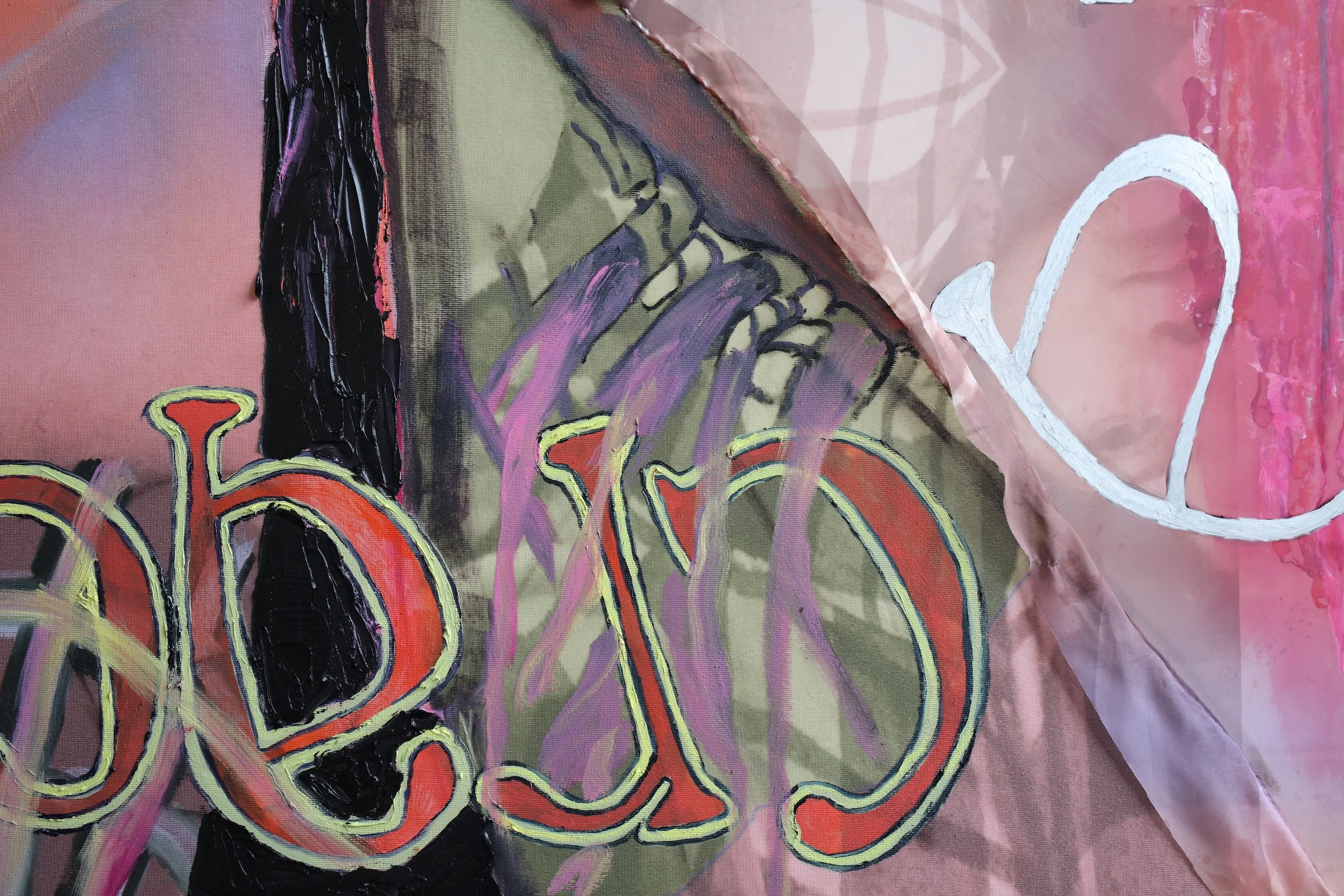
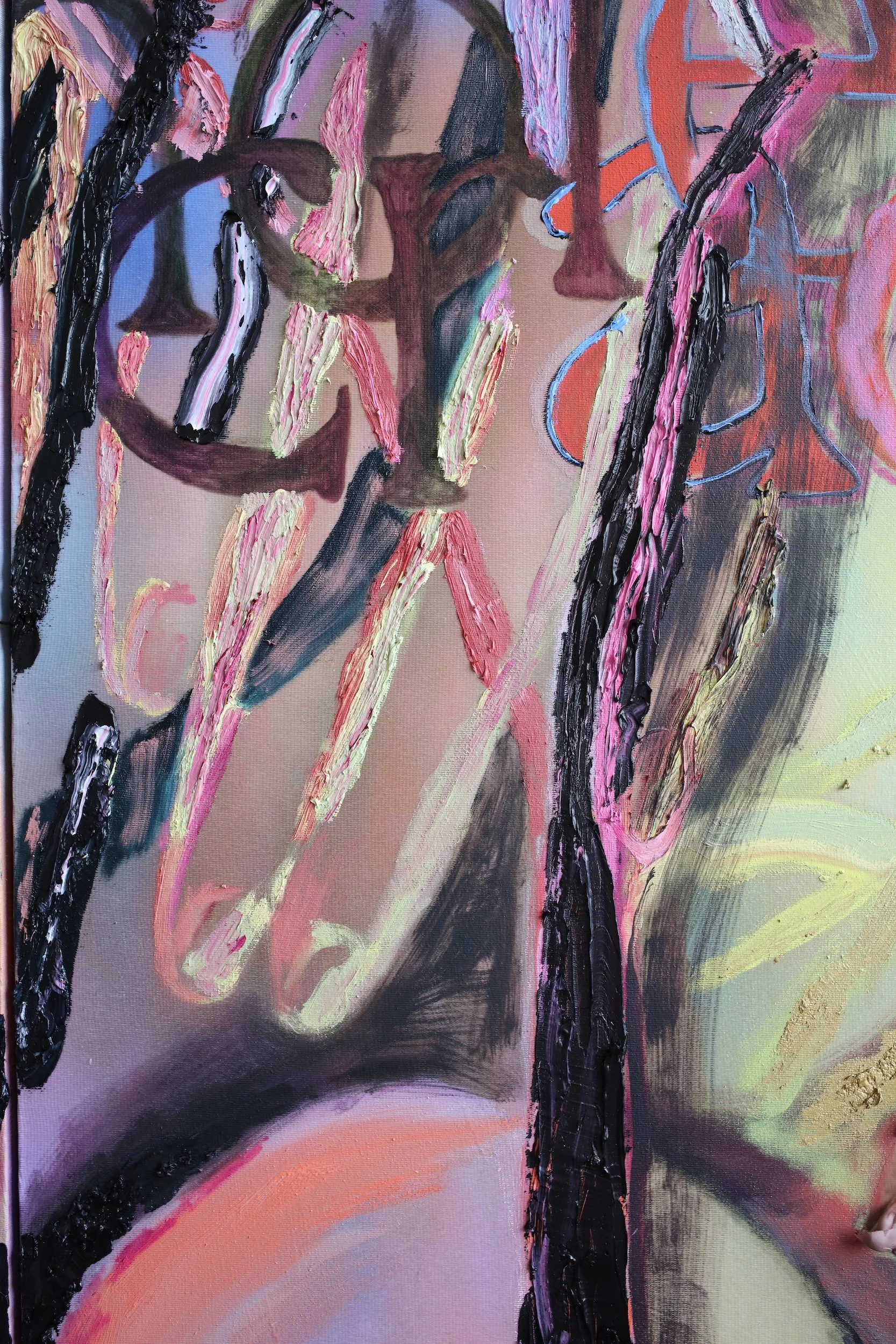
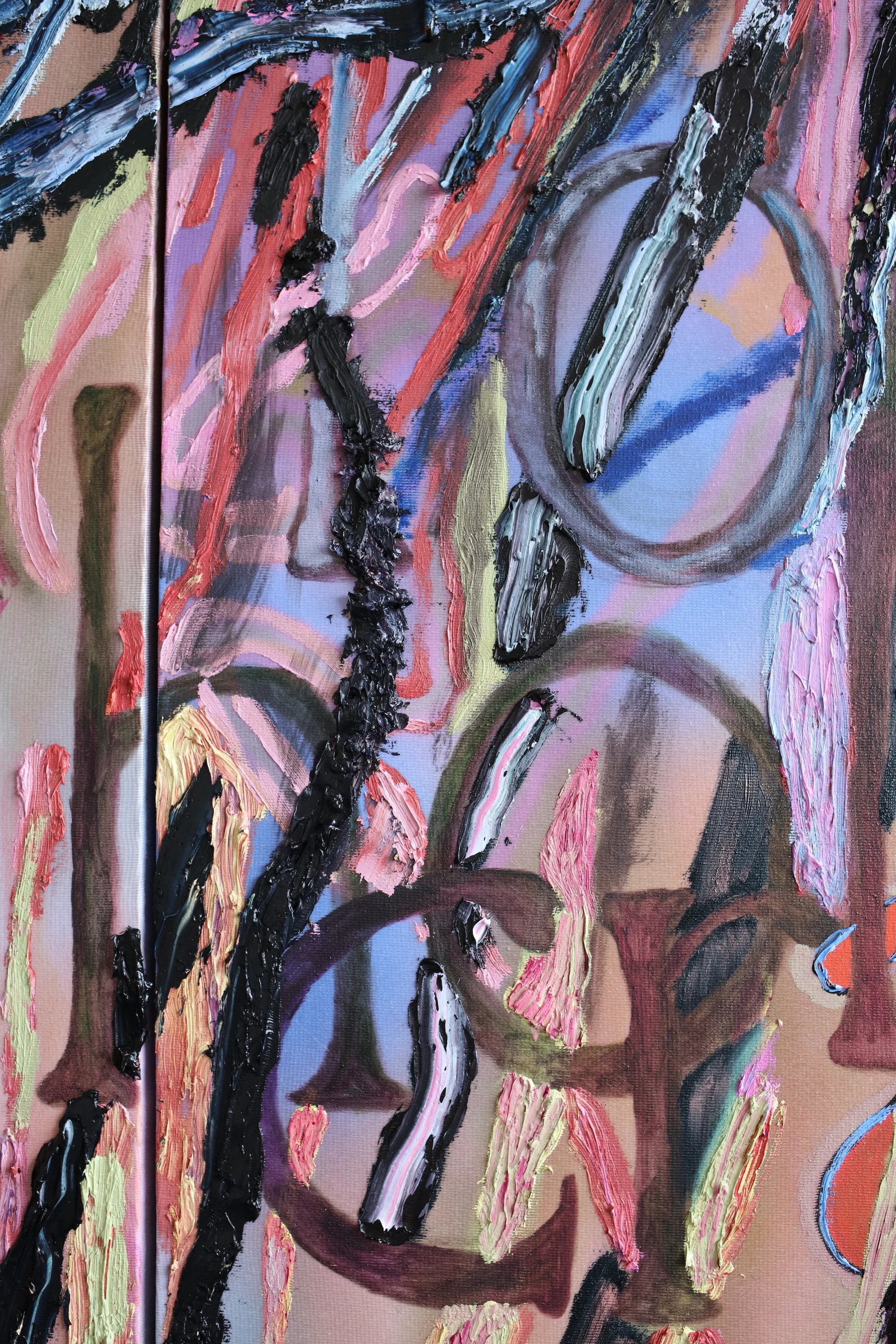
Fracture Mechanics is a painting about parts and wholes and holes; about the wish for similitude, and the pleasure that can be found even in the inevitable disappointment of this wish. There are two main characters in this painting, which is fitting, because the painting spreads across two stretcher bars. The first, is the text:
All looks are not a crack
holes
cracks
This is an interpolation of the Funkadelic song No Compute, a spoken sing-song about a one night stand that works out as intended, but not without its protagonist coming to the conclusion that "all looks are not alike; all holes are not a crack." There is a joke in there about aesthetics and desire and promiscuity; also of the dangers of confusing one thing for another. The text wraps around the right edge of the painting, making half of a loop.
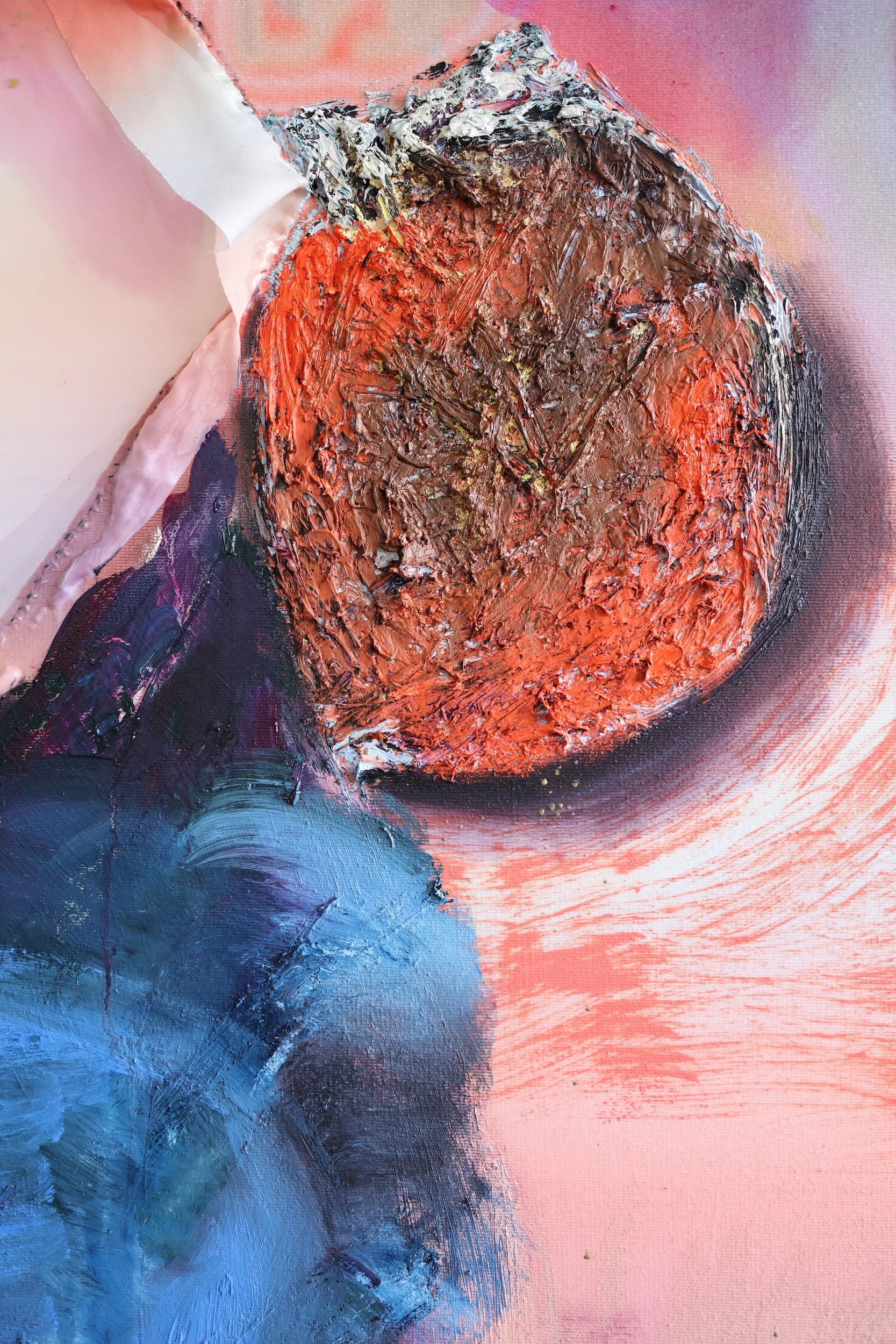
The other protagonist of the painting is a figure wearing plaid and no pants, bisected and rearranged across various axes. The painting was made by making the same, zig-zag cut across one large printed beach towel and one large printed piece of chiffon, and then swapping one side of each, so diptych is made of one half of each print, sewn together across the zag. The two towel sections occupy the two center portions of the panels, enjambed along the literal crack between the two panels; while the two chiffon sections occupy the outer left and right portions of the painting. Plaid butt girl, as I call her (based, as all of the photographic images in the show are, on a selfie), is cut in half and rearranged in the towel portions; in the chiffon portions, she has been printed as a two or four way mirror of herself (look for her eye in the "o" of "not").
Intervening among these and between them is a hand, reflected both in chiffon and towel. The hand was taken from the Piero della Francesca painting, the Madonna del Parto, located in the town of Monterchi in Umbria. It is one of the only renaissance paintings made of a pregnant person, and I am eternally interested in the drama of these reflected angels within a womblike tent, opening or closing the curtains of a scene of Mary, enormously pregnant and touching a very labial gap in her dress. I use these fingers to try to tease the image, either apart or closed, to make the space between text and image a tactile one. As in any reflection or portrait, what we see back is imperfect, incomplete—all looks are not alike. Over the surface of the painting are red and blue dots which seem to me to function like the dots one might see when you get up too fast and get dizzy—a reminder that even the imaginary is materially connected to the body.
For me, this painting is about puns, jokes, sincere desires and propositions about space and an imaginary which is able to hold disparate references and sense memories together.